How does NeuroEnergizer work?
NeuroEnergizer combines a short binaural-beats track with a simple sit-still-and-listen routine. This page separates the proposed mechanism from what research actually supports, so you can judge it fairly.
Affiliate disclosure: This is a resource site. Some links to NeuroEnergizer are affiliate links, and we may earn a commission if you buy through them at no extra cost to you. See our full affiliate disclosure. This page is informational and is not medical advice.
The proposed mechanism, step by step
- Two tones, one per ear. Through headphones, each ear receives a pure tone a few hertz apart, say 200 Hz and 206 Hz.
- The brain perceives a beat. You “hear” a 6 Hz pulse that is not physically present in either channel. This is a real perceptual phenomenon.
- Entrainment (the claim). The theory is that neural activity begins to align with that pulse frequency, easing the brain toward the associated state, here, a relaxed theta rhythm.
- A calmer baseline for the task ahead. You finish the track and move into work or sleep from a steadier starting point.
The marketing adds a layer about stimulating the corpus callosum and the brain’s attention filter (the reticular activating system). Those structures are real; the claim that a few minutes of audio meaningfully trains them is not established.
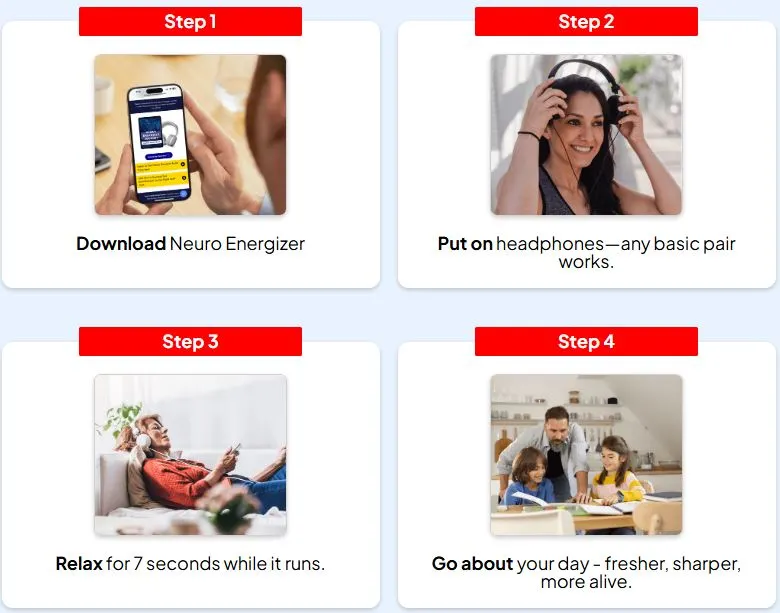
What the research supports, and what it doesn’t
Binaural beats have a reasonable body of study. A 2022 meta-analysis in Psychological Research pooled dozens of effect sizes and found an overall small-to-moderate average benefit for memory and attention (Hedges’ g around 0.4), while stressing that individual studies disagree. Earlier reviews link binaural beats with modest reductions in anxiety. On the other hand, a 2023 systematic review of entrainment found roughly as many studies showing no oscillatory change as showing one, and at least one large experiment found listening during a test slightly hurt performance.
Bottom line. This kind of audio may give some people a small nudge toward calm or concentration. It is not a strong or guaranteed effect, it may not work for you, and NeuroEnergizer’s specific track has never been published in a peer-reviewed trial.
The part that almost certainly does something: the ritual
Stopping what you are doing, putting on headphones, and spending five minutes breathing slowly is a deliberate state-change. Cognitive research on task-switching and attention residue suggests a clean break between tasks helps you engage with the next one. If NeuroEnergizer helps you, a good share of that is likely the structured pause it gives you, which is still a real, useful thing.
Headphones and why they matter
The binaural-beats mechanism depends on each ear getting its own tone, so stereo headphones or earbuds are required. Played on a speaker, the two tones mix in the air and the effect is lost. Isochronic tones, which some tracks add, are single pulsing tones that do not need headphones, but the core NeuroEnergizer experience is designed for headphone listening.
How to give it a fair test
Use it once daily at the same time for two to three weeks, right before a consistent activity (a work block or study session). Keep a one-line note each day on how focused you felt. If you see nothing after a few weeks, it is not for you, and the 60-day guarantee exists for exactly that situation. Full instructions are on the how-to-use page.
How-it-works questions
Does NeuroEnergizer change my brainwaves?
The theory of brainwave entrainment suggests rhythmic audio can nudge brain rhythms, but the evidence that this reliably happens is mixed. Any benefit you feel may come as much from the quiet pause and slow breathing as from the tones themselves.
Why theta frequencies?
Theta (about 4–8 Hz) is associated with deep relaxation, daydreaming and the transition to sleep. Producers choose it to encourage a calm, receptive state rather than high alertness.
How fast does it work?
Any effect is immediate-and-mild at best: a calmer, more settled feeling during and just after the track. There is no evidence of lasting cognitive change from short daily listening.
Do I really need headphones?
For the binaural-beats part, yes. The “beat” only forms when each ear hears its own tone, so stereo headphones or earbuds are required. On a speaker the two tones mix in the air and the effect is lost. Any isochronic (pulsing) tones layered in do not need headphones.
Is the effect just placebo?
Expectation and the calming routine almost certainly play a large role, and some studies find no measurable brain-rhythm change at all. That does not make it worthless, a reliable calming cue is useful, but you should not expect an effect beyond what a few quiet minutes with slow breathing would give you.
Do I have to concentrate on the sound?
No. The usual instruction is the opposite: let the audio sit in the background of your attention while you sit or lie still with your eyes closed or softly focused. Trying hard tends to work against the relaxation the track is meant to support.
Does the time of day matter?
Not for the mechanism, but consistency helps. Attaching the session to the same daily moment, before a work block, on an afternoon break, or as part of a wind-down routine, makes it a dependable cue. A low-frequency track is generally used for calm rather than as a wake-up.
Can I get the same thing from free binaural beats online?
Broadly, yes. Free binaural-beats and focus tracks on streaming platforms use the same underlying idea. NeuroEnergizer’s pitch is a single short pre-made session plus a simple routine and a refund window, not a unique technology.
Is it safe to listen every day?
For most people, listening to quiet audio daily is low-risk. Keep the volume moderate to protect your hearing, do not listen while driving, and if you have epilepsy or a seizure disorder ask your doctor before using binaural or pulsing audio.
Will it help if my focus problems come from poor sleep or stress?
Not directly. Audio does not address sleep debt, chronic stress or an overloaded schedule, which are the most common causes of poor focus. Treat it as a small add-on once those fundamentals are handled; see how to improve focus.
NeuroEnergizer
Want the price, contents and guarantee in one place?
See the current price, what comes in the package and how the 60-day money-back guarantee works. Prices and promotions change, so confirm them on the official page.
See how NeuroEnergizer works on the official page
The official page describes the current track and routine in the maker's own words. Opens in a new tab.
Pricing, bonuses and the money-back window are set by the official store and can change, always confirm on the official page.
Sources & further reading
Selected peer-reviewed studies and authoritative resources on binaural beats, brainwave audio, attention, sleep and related topics. These describe the research field in general; they are not studies of NeuroEnergizer, which has not been tested in a published trial.
- Garcia-Argibay M, Santed MA, Reales JM. “Efficacy of binaural auditory beats in cognition, anxiety, and pain perception: a meta-analysis.” Psychological Research 83(2):357–372, 2019. Source
- Ingendoh RM, Posny ES, Heine A. “Binaural beats to entrain the brain? A systematic review of the effects of binaural beat stimulation on brain oscillatory activity.” PLoS ONE 18(5):e0286023, 2023. Source
- Colzato LS, Barone H, Sellaro R, Hommel B. “More attentional focusing through binaural beats: evidence from the global–local task.” Psychological Research 81(1):271–277, 2017. Source
- López-Caballero F, Escera C. “Binaural beat: a failure to enhance EEG power and emotional arousal.” Frontiers in Human Neuroscience 11:557, 2017. Source
- Orozco Perez HD, Dumas G, Lehmann A. “Binaural beats through the auditory pathway: from brainstem to connectivity patterns.” eNeuro 7(2), 2020. Source
- Jirakittayakorn N, Wongsawat Y. “Brain responses to a 6-Hz binaural beat: effects on general theta rhythm and frontal midline theta activity.” Frontiers in Neuroscience 11:365, 2017. Source
- Solcà M, Mottaz A, Guggisberg AG. “Binaural beats increase interhemispheric alpha-band coherence between auditory cortices.” Hearing Research 332:233–237, 2016. Source
- Gao X, Cao H, Ming D, et al. “Analysis of EEG activity in response to binaural beats with different frequencies.” International Journal of Psychophysiology 94(3):399–406, 2014. Source
- Goodin P, Ciorciari J, Baker K, et al. “A high-density EEG investigation into steady state binaural beat stimulation.” PLoS ONE 7(4):e34789, 2012. Source
- Notbohm A, Kurths J, Herrmann CS. “Modification of brain oscillations via rhythmic light stimulation provides evidence for entrainment but not for superposition of event-related responses.” Frontiers in Human Neuroscience 10:10, 2016. Source
- Thut G, Schyns PG, Gross J. “Entrainment of perceptually relevant brain oscillations by non-invasive rhythmic stimulation of the human brain.” Frontiers in Psychology 2:170, 2011. Source
- Keitel C, Quigley C, Ruhnau P. “Stimulus-driven brain oscillations in the alpha range: entrainment of intrinsic rhythms or frequency-following response?” Journal of Neuroscience 34(31):10137–10140, 2014. Source
- Picton TW, John MS, Dimitrijevic A, Purcell D. “Human auditory steady-state responses.” International Journal of Audiology 42(4):177–219, 2003. Source
- National Institute of Neurological Disorders and Stroke. “Brain Basics: Understanding Sleep” (brainwave frequency bands and states). Source
- Draganski B, Gaser C, Busch V, et al. “Neuroplasticity: changes in grey matter induced by training.” Nature 427:311–312, 2004. Source