How to use NeuroEnergizer
A simple, repeatable way to use NeuroEnergizer, plus a two-week test so you can decide honestly whether it helps before the guarantee runs out.
Affiliate disclosure: This is a resource site. Some links to NeuroEnergizer are affiliate links, and we may earn a commission if you buy through them at no extra cost to you. See our full affiliate disclosure. This page is informational and is not medical advice.
Setup (once)
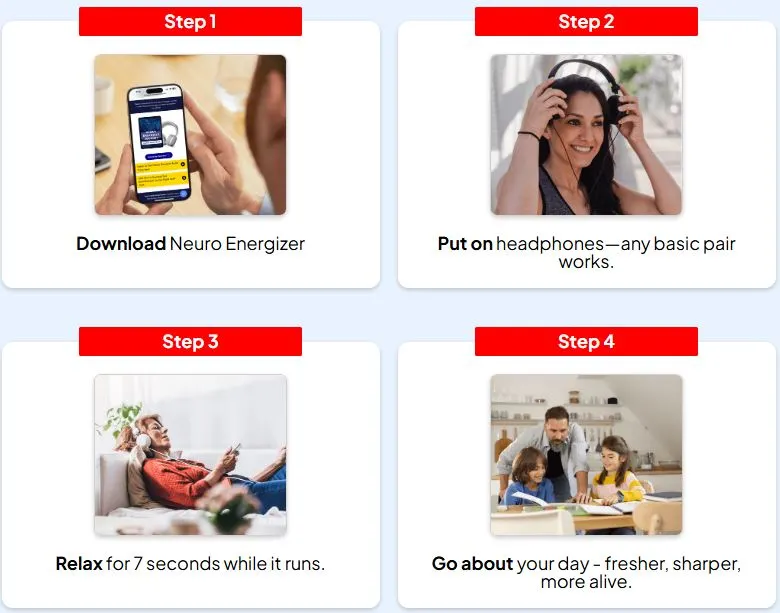
- Download and save the files. After purchase you get instant access. Save the audio to your phone and a backup on your computer.
- Get stereo headphones or earbuds. Wired or wireless is fine; the key is separate left and right channels. Speakers will not deliver the binaural-beats effect.
- Pick a fixed trigger. Choose one moment to attach it to, the start of your morning work block, or the start of evening study.
A single session
- Sit or lie somewhere quiet where you will not be interrupted for about ten minutes.
- Put your headphones on and set the volume low, comfortably below the level you’d use for music.
- Play the core track. Close your eyes or let your gaze go soft. Breathe slowly, in for four, out for six.
- Don’t “try” to do anything. Let the sound be in the background of your attention.
- When it ends, start your task straight away. The point is to carry the settled state into the work.
When people use it
- Before focused work, as the on-ramp to a deep-work block.
- On a mid-afternoon break, to reset when energy dips.
- Before studying, to shift from casual phone use into revision.
- In the evening, as part of a wind-down routine before sleep.
Pick one or two of these to start. Consistency at the same time each day matters more than which slot you choose.
The two-week test
To judge it fairly:
- Use it once a day, same time, same activity afterwards, for 14 days.
- Each day, rate your focus for that session from 1 to 5 in a notes app, one line, no analysis.
- After two weeks, look at the trend. A clear upward drift, or simply finding it easier to start, is a reason to keep going. Nothing at all is a reason to request a refund while you are still inside the window.
Safety notes
- Keep the volume low to protect your hearing; you should still hear a knock at the door.
- If you have epilepsy or any seizure disorder, ask your doctor before using binaural or pulsing audio.
- Never listen while driving or operating machinery.
- Stop if it makes you feel dizzy, anxious or unwell. It is just audio, there is no benefit to pushing through discomfort.
Using the bonus guides
Skim The Brain Fuel Guide and Habits of High Achievers once for anything you can actually apply, a hydration habit, a shutdown routine, and use The Brain Optimizer exercises if you enjoy that kind of thing. They are supplements to the routine, not the main event.
Usage questions
How many times a day should I listen?
Once is enough for a routine. Some people add a second short session on a break. More is not better, and very long listening sessions are unnecessary.
Can I listen while working or driving?
Use it as a pre-task ritual, not background audio, and never while driving or operating machinery. It is meant to be listened to with your eyes closed or softly focused.
Is it safe?
For most people, listening to quiet audio is low-risk. Do not use binaural or pulsing audio if you have epilepsy or a seizure disorder without asking your doctor first, and keep the volume low to protect your hearing.
What if I feel nothing?
That is common. Give it two to three consistent weeks; if there is still no benefit, use the money-back guarantee.
NeuroEnergizer
Get instant access and start the two-week test
Digital delivery is immediate, and the 60-day guarantee covers your trial. Check current terms on the official page.
Pricing, bonuses and the money-back window are set by the official store and can change, always confirm on the official page.
Sources & further reading
Selected peer-reviewed studies and authoritative resources on binaural beats, brainwave audio, attention, sleep and related topics. These describe the research field in general; they are not studies of NeuroEnergizer, which has not been tested in a published trial.
- Garcia-Argibay M, Santed MA, Reales JM. “Efficacy of binaural auditory beats in cognition, anxiety, and pain perception: a meta-analysis.” Psychological Research 83(2):357–372, 2019. Source
- Chaieb L, Wilpert EC, Reber TP, Fell J. “Auditory beat stimulation and its effects on cognition and mood states.” Frontiers in Psychiatry 6:70, 2015. Source
- Jirakittayakorn N, Wongsawat Y. “Brain responses to a 6-Hz binaural beat: effects on general theta rhythm and frontal midline theta activity.” Frontiers in Neuroscience 11:365, 2017. Source
- National Institute on Deafness and Other Communication Disorders. “Noise-Induced Hearing Loss.” Source
- Epilepsy Foundation. “Photosensitivity and Seizures.” Source
- World Health Organization. “Deafness and hearing loss” fact sheet (safe-listening levels). Source
- National Center for Complementary and Integrative Health. “Relaxation Techniques: What You Need To Know.” Source
- National Institute of Neurological Disorders and Stroke. “Brain Basics: Understanding Sleep” (brainwave frequency bands and states). Source
- Zeidan F, Johnson SK, Diamond BJ, David Z, Goolkasian P. “Mindfulness meditation improves cognition: evidence of brief mental training.” Consciousness and Cognition 19(2):597–605, 2010. Source
- Basso JC, McHale A, Ende V, Oberlin DJ, Suzuki WA. “Brief, daily meditation enhances attention, memory, mood, and emotional regulation in non-experienced meditators.” Behavioural Brain Research 356:208–220, 2019. Source
- Killgore WDS. “Effects of sleep deprivation on cognition.” Progress in Brain Research 185:105–129, 2010. Source