NeuroEnergizer benefits: what to realistically expect
Marketing for audio programs tends to over-promise. This page describes what NeuroEnergizer is designed to support, using careful language, and flags the claims you should ignore.
Affiliate disclosure: This is a resource site. Some links to NeuroEnergizer are affiliate links, and we may earn a commission if you buy through them at no extra cost to you. See our full affiliate disclosure. This page is informational and is not medical advice.
Benefits people commonly report
An easier start to deep work
A short track can act as a “first domino”, a small, easy action that leads into the harder task, reducing procrastination at the starting line.
A calmer pre-study environment
Students often use it to settle before revision, especially to block out a noisy room and mark the shift from scrolling to studying.
A genuine break
Five minutes with headphones and eyes closed is a real pause between meetings, more restorative than another feed refresh.
A wind-down cue in the evening
Low-frequency audio as part of a consistent bedtime routine can help signal “the day is done.”
Notice the framing: these are routine benefits. The track gives you a repeatable trigger; consistency does the rest.
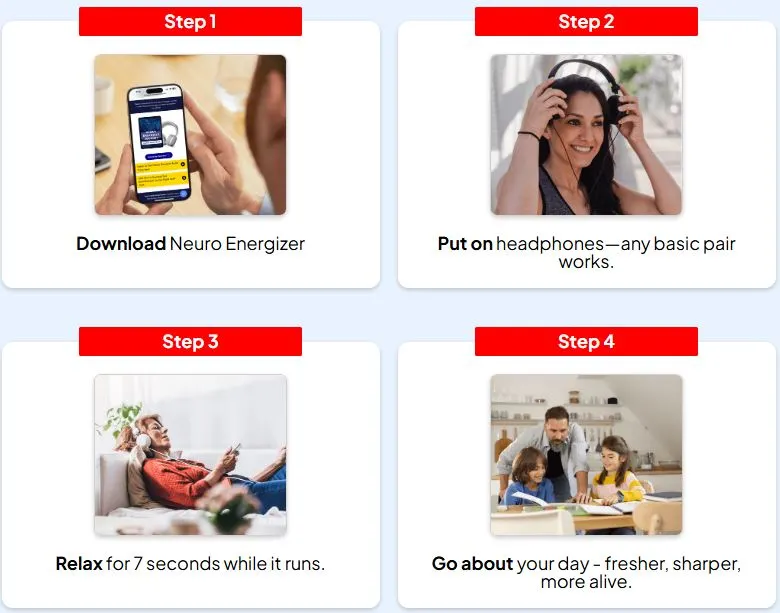
How to describe the effect honestly
Reasonable language: “designed to support focus,” “intended to help you settle,” “may be useful as part of a focus routine,” “some people find it relaxing.”
Language to avoid, because it is not supported: “guaranteed results,” “proven to increase IQ,” “rewires your brain,” “cures brain fog,” “activates your genius.”
Claims we will not repeat
The wider marketing for this product has at times linked it to promotions, raises, debt payoff, anxiety relief and memory recovery in older adults. There is no evidence for outcomes like these, and we do not present them as benefits.
Customer feedback
Customer experiences
Shared by the vendor with permission. Individual accounts, not typical results.
“I’ve tried meditation apps, focus music, and different productivity techniques, but I liked how simple Neuro Energizer was to fit into my routine. I started listening before work, and after a few days, I felt more settled and less overwhelmed when starting difficult tasks. I also found it easier to get into a focused mindset. The short sessions were a big plus because I didn’t have to commit a lot of time.”
“As a student, I’m always looking for ways to create a better study routine. I started using Neuro Energizer before longer study sessions, and I found the audio helpful for creating a calmer environment before getting started. It didn’t magically make studying easy, but it became a useful part of my routine when I needed to concentrate and block out distractions.”
“I was skeptical at first because I’ve tried plenty of focus and relaxation tools that I stopped using after a few days. What I liked about Neuro Energizer was how straightforward it was. I just put on my headphones and listened as part of my daily routine. Over time, I found the sessions relaxing and helpful when I wanted to clear my head and reset before work.”
Who tends to benefit least
- People whose focus problems are mainly driven by sleep debt, chronic stress or an unmanageable workload, the audio does not touch the cause.
- People who dislike sitting still or find tones distracting.
- Anyone expecting a dramatic, obvious change from day one.
Getting the most from it
Pair the track with the fundamentals in how to improve focus: protect your sleep, batch notifications, work in defined blocks, and take real breaks. Use NeuroEnergizer as the on-ramp to a block, not as the whole strategy. The how-to-use guide has a simple two-week test protocol.
Benefit questions
What is the single most realistic benefit?
An easier, more consistent transition into focused work or rest, because you have a defined cue that takes only a few minutes.
Will it improve my memory or IQ?
There is no published evidence that NeuroEnergizer improves memory or IQ. General binaural-beats research on memory is mixed and, where positive, small.
Can it help me relax before sleep?
Some people use low-frequency audio as part of a wind-down routine and find it calming. That is a reasonable use; it is not a treatment for insomnia.
NeuroEnergizer
Check the current offer and guarantee
If you want to test the routine yourself, the 60-day money-back guarantee is designed for exactly that. Confirm terms on the official page.
Pricing, bonuses and the money-back window are set by the official store and can change, always confirm on the official page.
Sources & further reading
Selected peer-reviewed studies and authoritative resources on binaural beats, brainwave audio, attention, sleep and related topics. These describe the research field in general; they are not studies of NeuroEnergizer, which has not been tested in a published trial.
- Garcia-Argibay M, Santed MA, Reales JM. “Efficacy of binaural auditory beats in cognition, anxiety, and pain perception: a meta-analysis.” Psychological Research 83(2):357–372, 2019. Source
- Ingendoh RM, Posny ES, Heine A. “Binaural beats to entrain the brain? A systematic review of the effects of binaural beat stimulation on brain oscillatory activity.” PLoS ONE 18(5):e0286023, 2023. Source
- Chaieb L, Wilpert EC, Reber TP, Fell J. “Auditory beat stimulation and its effects on cognition and mood states.” Frontiers in Psychiatry 6:70, 2015. Source
- Reedijk SA, Bolders A, Hommel B. “The impact of binaural beats on creativity.” Frontiers in Human Neuroscience 7:786, 2013. Source
- Isik BK, Esen A, Büyükerkmen B, et al. “Effectiveness of binaural beats in reducing preoperative dental anxiety.” British Journal of Oral and Maxillofacial Surgery 55(6):571–574, 2017. Source
- Garcia-Argibay M, Santed MA, Reales JM. “Binaural auditory beats affect long-term memory.” Psychological Research 83(6):1124–1136, 2019. Source
- National Center for Complementary and Integrative Health. “Relaxation Techniques: What You Need To Know.” Source
- Zeidan F, Johnson SK, Diamond BJ, David Z, Goolkasian P. “Mindfulness meditation improves cognition: evidence of brief mental training.” Consciousness and Cognition 19(2):597–605, 2010. Source
- Basso JC, McHale A, Ende V, Oberlin DJ, Suzuki WA. “Brief, daily meditation enhances attention, memory, mood, and emotional regulation in non-experienced meditators.” Behavioural Brain Research 356:208–220, 2019. Source
- Lim J, Dinges DF. “A meta-analysis of the impact of short-term sleep deprivation on cognitive variables.” Psychological Bulletin 136(3):375–389, 2010. Source
- Scott AJ, Webb TL, Martyn-St James M, Rowse G, Weich S. “Improving sleep quality leads to better mental health: a meta-analysis of randomised controlled trials.” Sleep Medicine Reviews 60:101556, 2021. Source
- U.S. Food and Drug Administration. “General Wellness: Policy for Low Risk Devices” (guidance). Source
- Federal Trade Commission. “Health Products Compliance Guidance” (2022). Source